Dec 30, 2017
I worked through the effect of changing windows.
The comparison is between a mainstream Japanese high-grade resin window and a Passive House-spec window.
(For reference, comparable products from the other major Japanese maker are slightly behind and considered roughly equivalent to the first — both are recent-but-not-current high-grade options.)
The comparison is for a typical patio door of 160 cm wide × 200 cm tall.
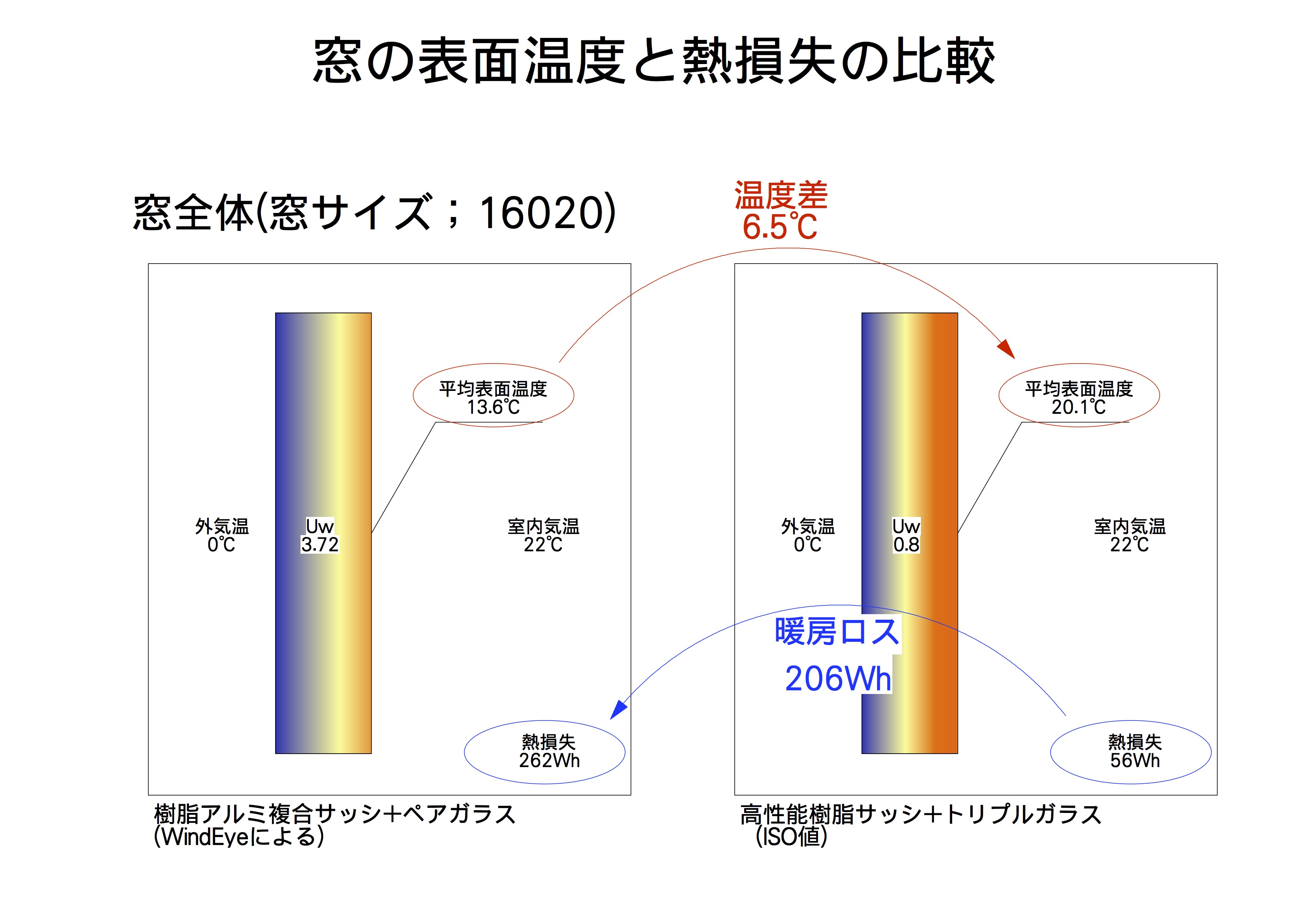
If you have three of these windows, the effect equals one 600W ceramic fan heater. With an air conditioner, you can drop a grade from a 12-tatami model to a 10-tatami model.
Energy saving
The energy saving per window: ¥120/day.
That's 0.2 kW per hour, or 4.8 kW over 24 hours. At ¥25/kWh, 4.8 kWh = ¥120/day.
(Calculated for a ceramic fan heater. With an air conditioner, it's roughly one-third.)
Felt temperature
The window's surface temperature (average across the whole window) differs by 6.5 °C. The felt temperature near the window also drops significantly.
(Felt temperature is often calculated as the average of surrounding surface temperatures and the air temperature.)
Condensation
At an indoor temperature of 22 °C and 50% relative humidity, condensation begins when the window surface drops to 11 °C.
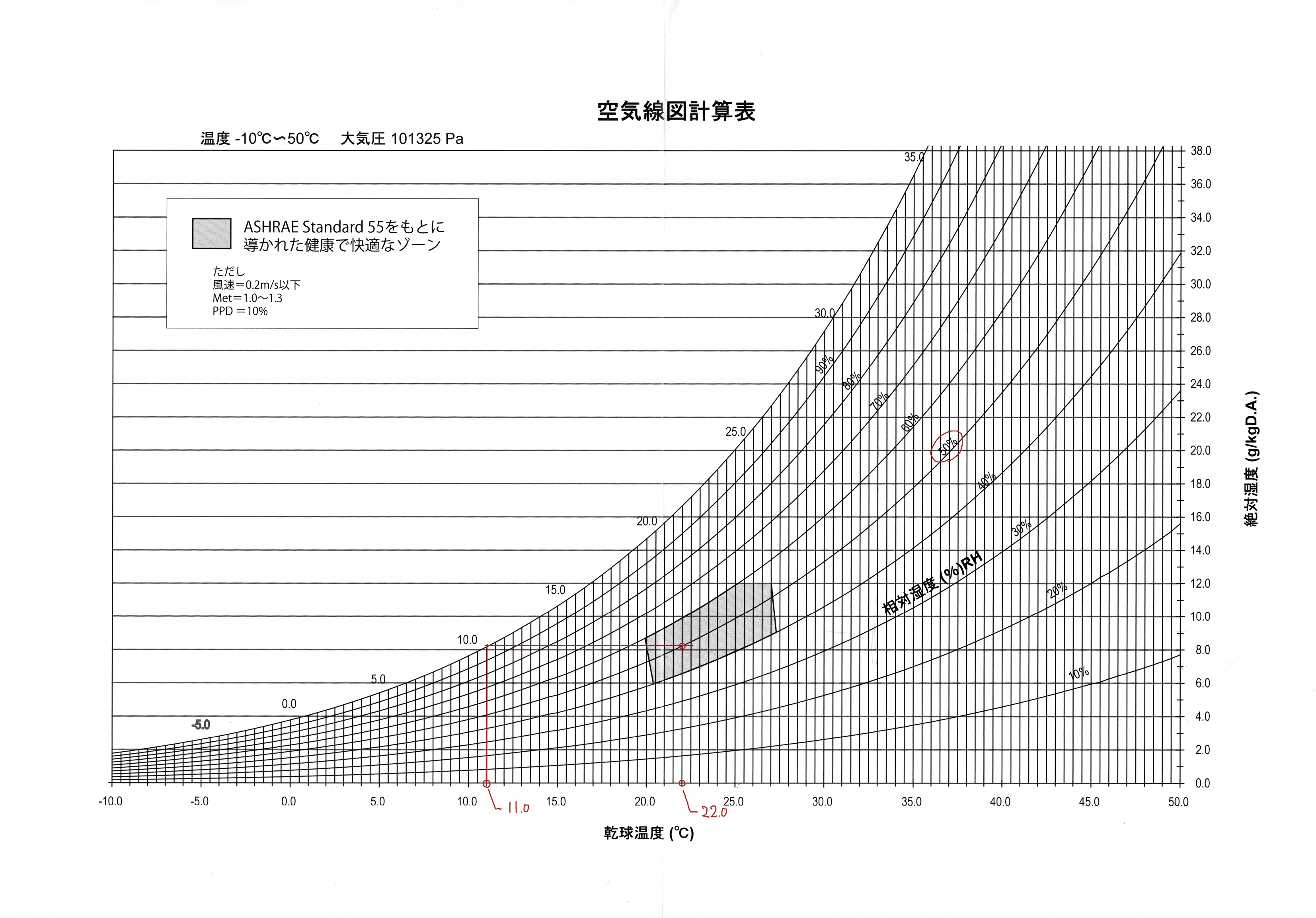
In this comparison, even the lower-performance window has an average surface temperature of 13.6 °C, so technically no condensation. But there's a trick here — the average surface temperature is just an average; the glass area and the frame area have very different surface temperatures.
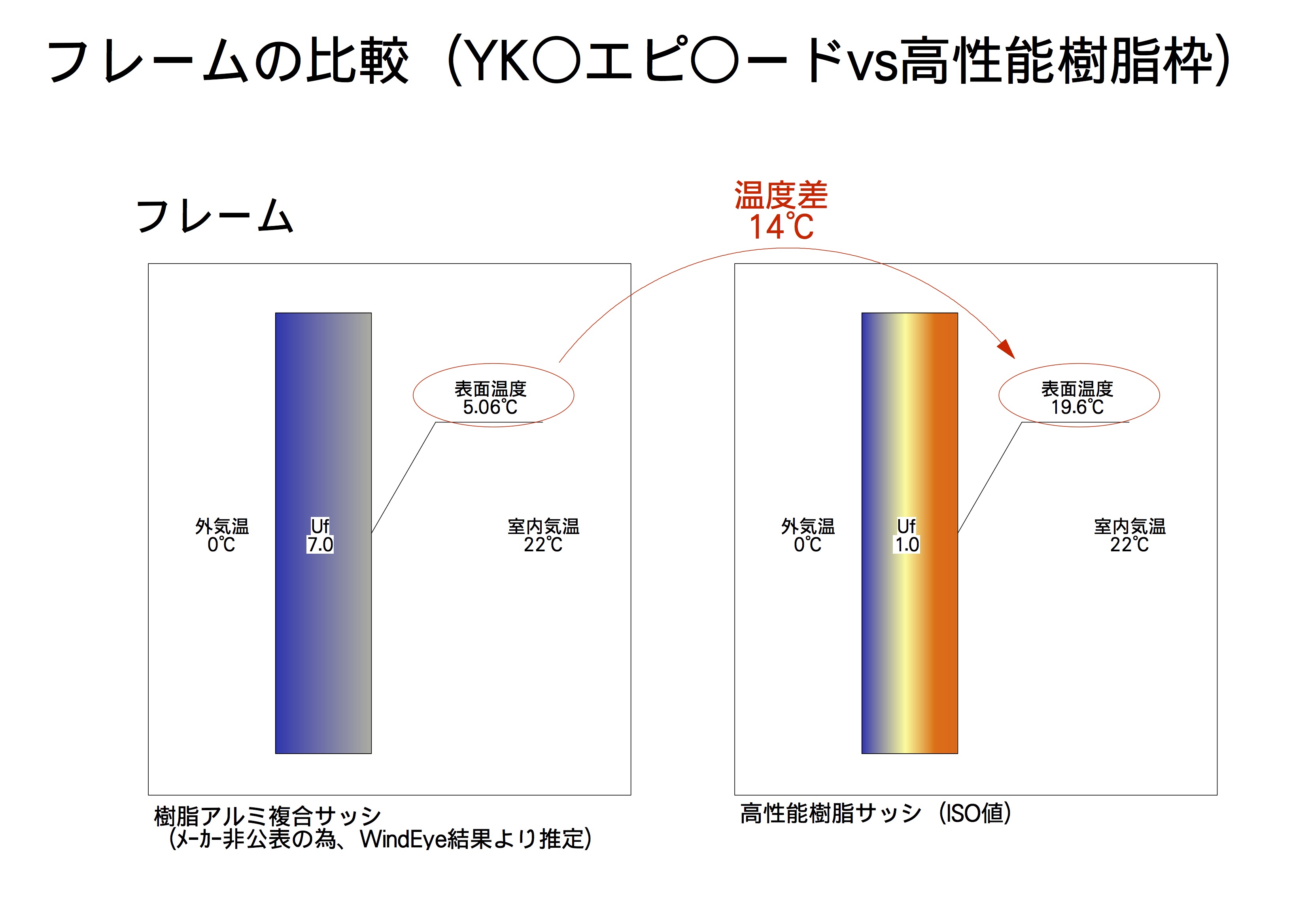
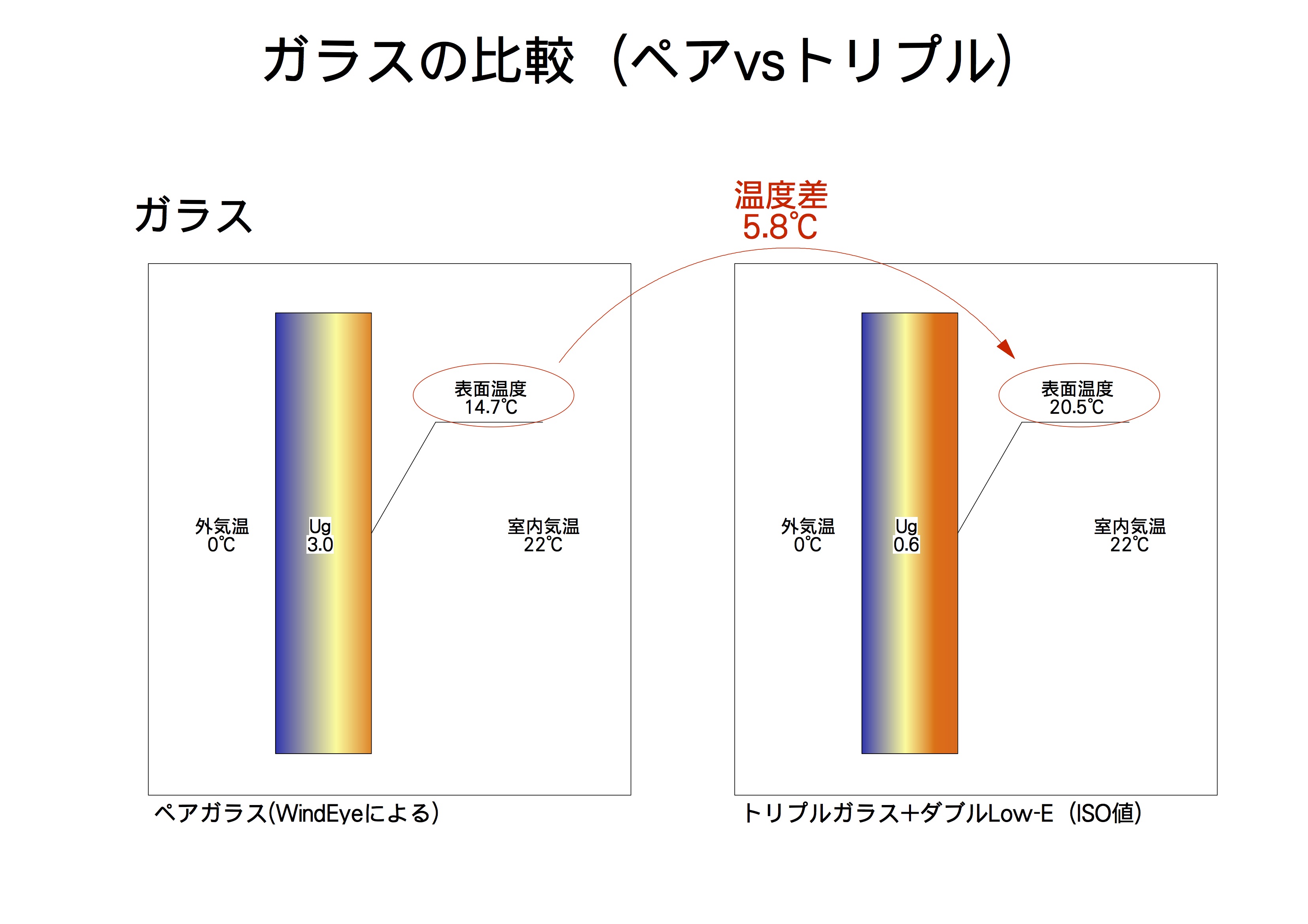
The glass surface temperature isn't that low, but the frame surface temperature drops to 5.06 °C. This will absolutely condense. It will condense even with the room quite dry. In winter we want to keep humidity above 40% to prevent skin dryness and reduce virus survival — but the window keeps dehumidifying the room instead.
Uf values are not disclosed by any maker
The Uf value is the U-value of the window frame. Together with the Ug value (U-value of the glass), it's needed to calculate the Uw value (U-value of the whole window). Japanese makers don't publish this number. There's no benefit to them in publishing it, so that's understandable — but it means we can't compare frame performance.
The Living Amenity Association publishes a calculation system called WindEye, which lets you compute frame area ratios and Uw values per window, so you can roughly back-calculate Uf values. Doing so, Uf comes out at 7.0 or higher. Even the top-grade Japanese window comes in at 2.0 or higher. No wonder they don't publish Uf.