Apr 24, 2018
There are still many people whose understanding of house foundations is shallow. This time I want to discuss the structure of the foundation.
House foundations come in several forms: strip footing, mat (slab) foundation, and isolated footings. All the houses I've worked on use mat foundations, so I'll focus on that here.
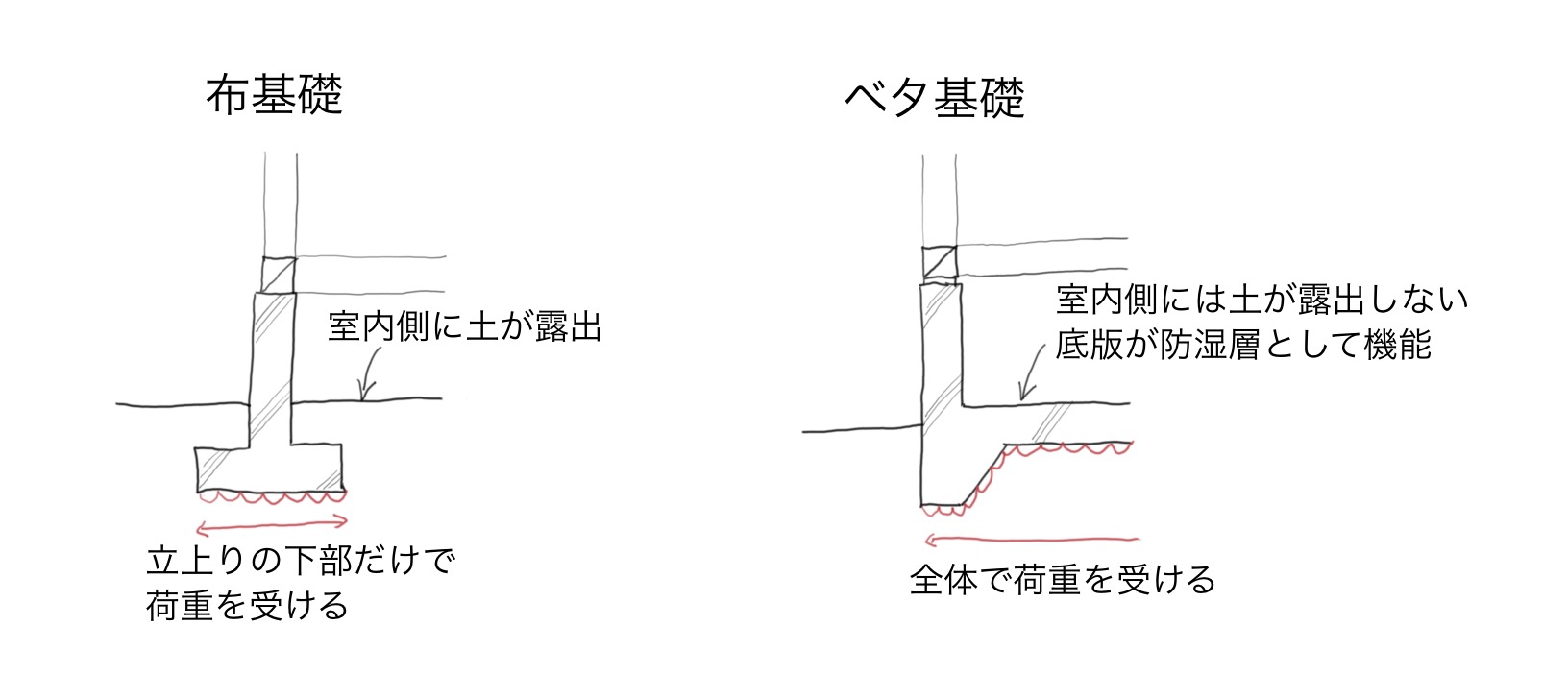
Fig. 1 (types of foundation)
A mat foundation is divided into a bottom slab and an upstand. The bottom slab receives ground reaction and transfers the building's load to the soil. The upstand carries the wooden frame and also functions as a beam.
Let's dig into the upstand's role as a beam.
What happens if the foundation doesn't function as a beam? No matter how strongly you plan the load-bearing walls above, they won't fully perform. In some cases, the bottom slab can be damaged during an earthquake.
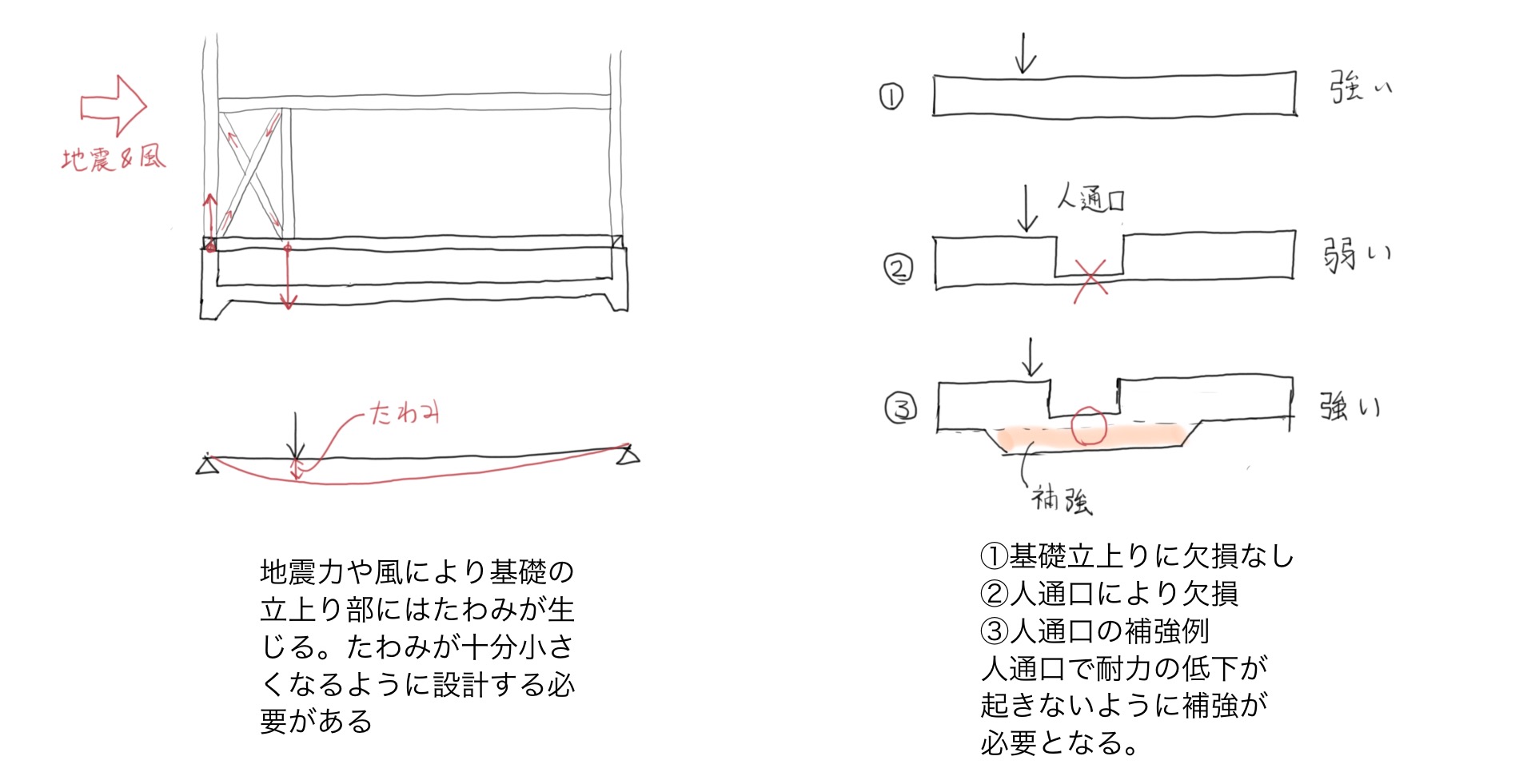
Fig. 2 (the beam function of a foundation)
Older houses often have strip footings without rebar, with short upstands, or with the upstand broken into segments. In seismic retrofitting, the biggest bottleneck is giving these "non-beam" foundations a beam function. In practice, the retrofit becomes large-scale work — you peel up much of the 1F floor and redo foundation work.
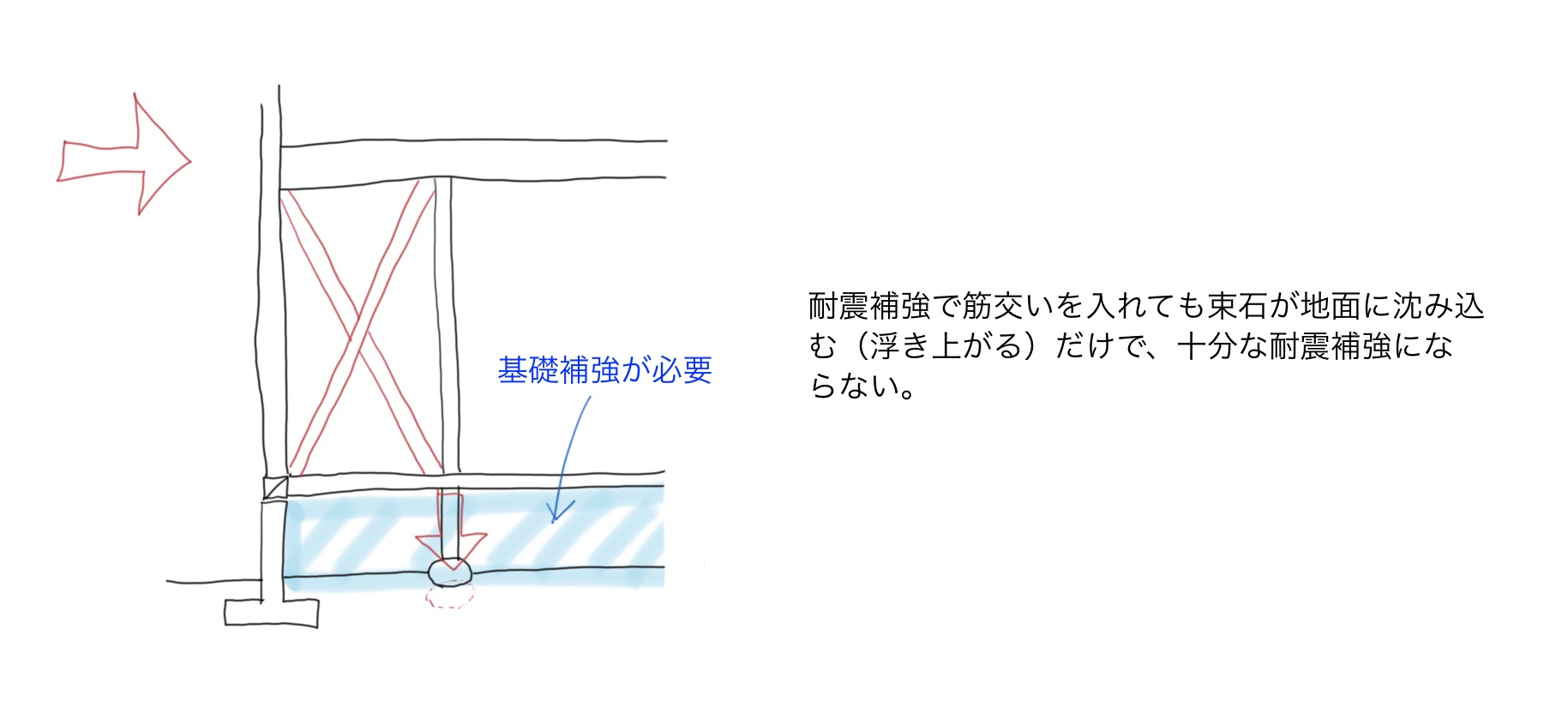
Fig. 3 (seismic retrofit)
Recent wooden houses increasingly use high-multiplier load-bearing walls (shear walls). In seismic retrofitting, walls of up to 10 kN are now allowed. With a 10 kN wall and a 3:1 aspect ratio, the column base sees an uplift of 3× 10 kN = 30 kN. If 10 kN walls stack on the 1st and 2nd floors, that becomes 60 kN. In reality the building weight pushes down, so it doesn't actually reach this much uplift, but using 50 kN hold-down hardware is hardly unusual. 50 kN means 5 tons of uplift. One side pulls with 5 t, the other side pushes down with 8 t — you can imagine the bending applied to the beam.
For these reasons, new or retrofit alike, the foundation must be designed to function as a beam that properly resists bending.